Creative hopelessness is the realization that our old control strategies don’t work because the pain that we are trying to avoid cannot be avoided. It leans on the sense of freedom that comes with accepting the pain that comes with being alive and the futility of trying to avoid it.
Once we accept that we cannot escape difficult experiences, we can stop fighting and use our energy instead for the things and activities that we value.
Creative hopelessness is about changing the way we relate to difficult thoughts and emotions, and it is an important element of enhancing psychological flexibility. It is about coming to terms with the fact that excessive control has not worked and will not work.
Instead, we need a new approach, one that forces us to think about our problems in completely different, more “creative” ways.
What Is Creative Hopelessness in ACT?
Creative hopelessness permeates many of the ideas that Acceptance and Commitment Therapy (ACT) is based on. Defusion and acceptance exercises, important elements of the ACT framework, aim to free us of the burden of unhelpful and unworkable control strategies. At the same time, ACT also emphasizes clarifying one’s values to lead a life that’s meaningful.
At its core, creative hopelessness is often the turning point in ACT. Before this point, much of our energy is spent trying to control, eliminate, or reduce unwanted thoughts and feelings. We analyze them, challenge them, suppress them, or try to outthink them.
In the short term, some of these strategies may provide relief. In the long term, however, they tend to reinforce the very patterns that keep us stuck. ACT gently brings this pattern into awareness. It asks a simple but uncomfortable question: Has this been working? Not in theory, but in your actual lived experience.
When the answer becomes clear, something shifts. This is not about giving up on feeling better. It is about giving up on strategies that, despite our best efforts, have not delivered the life we want. From there, ACT opens a different path, one based not on control, but on acceptance, presence, and values-based action.
Creative Hopelessness: A Practical Example
Picture this: you’ve just arrived at a new destination. It is a busy, bustling seaside city. It is full of life, full of distractions, and… full of noise. The problem is… you are very sensitive to noise.
Although you love the city’s vibrant personality, you feel a pang of anxiety every time a car zips past you while honking or when a kid screams at the top of their lungs for their mother.
You cope with these micro-shocks to your system with a never-ending array of strategies: you remind yourself that people in this country are more tolerant of noise than people in your country. You tell yourself that, actually, the noise doesn’t bother you at all.
However, every time you are startled by a noise, you feel the pang of anger rise within you, and you quickly feel the need to resort to one of the many control strategies you’ve been employing. And so it goes, without you even realizing it, you’re deploying a non-insignificant amount of resources to deal with these uncomfortable thoughts and emotions. Worst of all, it hasn’t helped one bit.
A bit downtrodden, you sit on a bench to ponder. And right then and there, you realize there is only one thing you haven’t done: accepting that the noise is there and that it will always be there, sometimes shocking you, sometimes mocking you like a willful bully. Instead of battling with it, you realize it makes more sense to focus on something that you value: the beauty of the chaos and of the way of being that unfolds in front of you.
What Is the Purpose of Creative Hopelessness?
The purpose of creative hopelessness is not to make you feel defeated. It is to help you see, clearly and honestly, that the strategies you have been relying on are not giving you the life you want.
In many cases, especially with OCD, these strategies are understandable. They are attempts to reduce anxiety, gain certainty, or protect yourself from harm. But over time, they tend to backfire. They consume your attention, reinforce doubt, and keep you stuck in repetitive cycles.
Creative hopelessness brings this pattern into focus. It helps you step back and ask: If this hasn’t worked so far, what am I holding on to?
This realization creates space. Space to stop investing energy in a losing struggle. Space to consider a different way of relating to your thoughts and emotions. And, most importantly, space to start moving toward what actually matters to you.
In that sense, creative hopelessness is not the end of the road. It is the beginning of a more workable one.
Creative Hopelessness Metaphors
Metaphors, like the paper prison, can be very useful to help us understand psychological concepts as they can feel a bit abstract. Here are a couple of metaphors often used to explain the concept of creative hopelessness.
The Chinese Finger Trap
The Chinese finger trap is a simple but powerful metaphor. When you place your fingers inside the trap and try to pull them out, the trap tightens. The harder you pull, the more stuck you become.
The only way to free yourself is to do the opposite of what your instincts tell you: you gently push your fingers inward, creating enough slack to release them.

In the same way, many of our control strategies tighten the grip of anxiety and intrusive thoughts. The more we try to escape them, the more entangled we become. Creative hopelessness is the moment we realize that pulling harder is not the solution and that a completely different approach is needed.
Tug of War
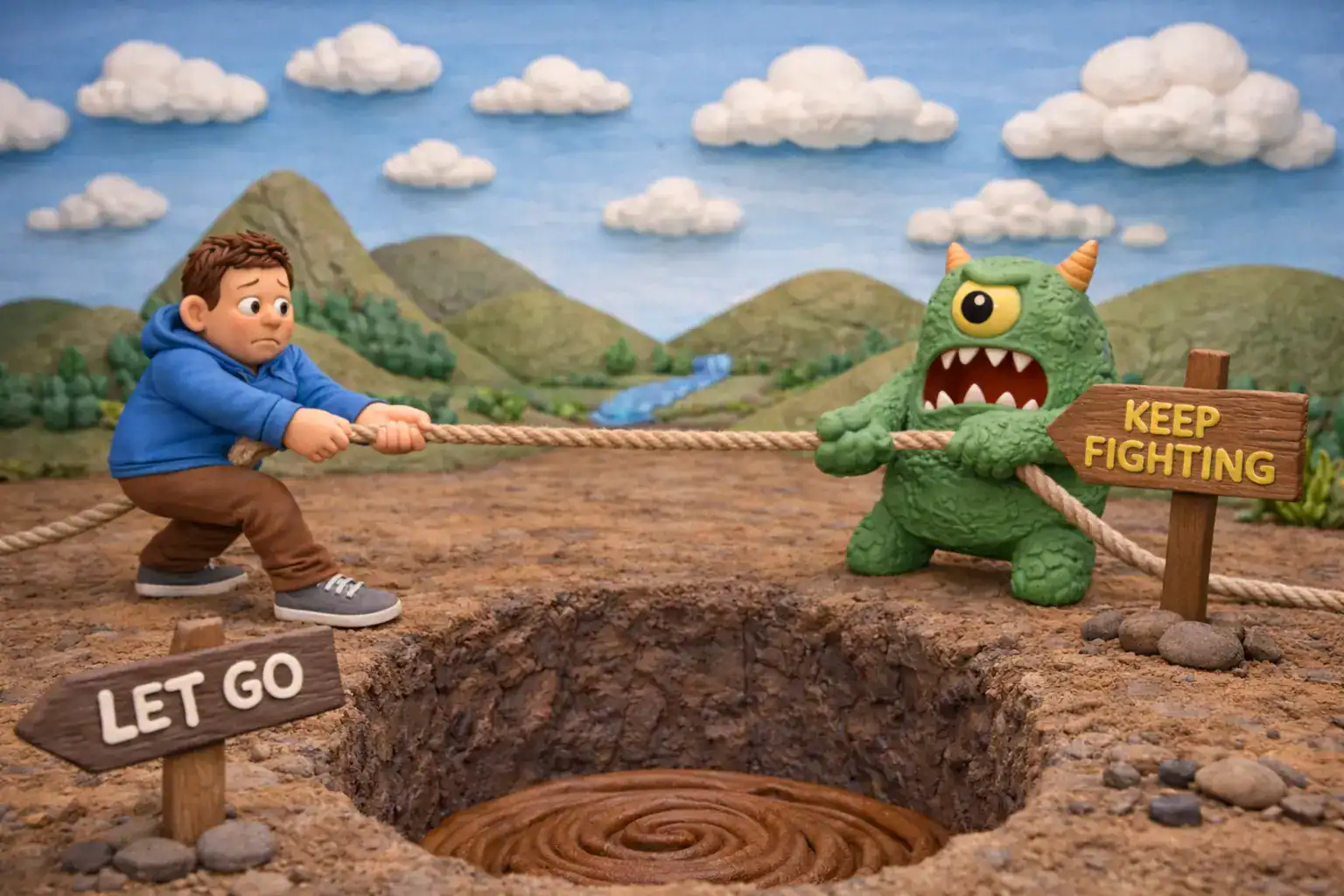
Imagine you are in a tug of war with a monster. On the other side of the rope is everything you fear: your intrusive thoughts, your anxiety, your doubts. Between you and the monster is a deep pit.
You pull with all your strength to avoid being dragged into the pit. The problem is, the monster pulls back just as hard. The struggle continues, exhausting and endless.
Creative hopelessness is the moment you realize that no matter how hard you pull, you cannot win this game. The only way out is to drop the rope.
Dropping the rope does not make the monster disappear. It simply ends the struggle. And in doing so, it frees you to step away from the pit and move in a different direction.
Creative Hopelessness: Final Thoughts
Creative hopelessness can feel uncomfortable at first. It asks you to question strategies that may have felt necessary, even protective, for a long time.
But there is something deeply liberating about seeing things as they are.
When you recognize that the struggle to control your inner experience is not working, you are no longer trapped in it in the same way. You can begin to loosen your grip, redirect your energy, and engage more fully with your life.
This is not about resignation. It is about honesty.
And from that honesty, a different kind of hope can emerge: one grounded not in eliminating discomfort, but in building a life that feels meaningful, even in its presence.
Leave a Reply