
False memory OCD is a form of obsessive-compulsive disorder in which a person becomes consumed by doubts about whether something happened in the past. These doubts often involve fears of having done something immoral, embarrassing, or harmful.
Unlike ordinary uncertainty about memory, false memory OCD creates intense anxiety and a powerful urge to “figure out the truth.” The more a person analyzes the memory, the more convincing the imagined scenario can become.
These doubts can feel incredibly convincing. A person may mentally replay a situation over and over, trying to determine whether something actually happened. Instead of gaining clarity, this repeated analysis often creates even more confusion and anxiety.
False memory OCD is closely related to real event OCD, another subtype where the focus is on something that actually happened in the past but becomes exaggerated or distorted by obsessive rumination.
This pattern is sometimes called blackout OCD, especially when someone fears they may have behaved badly during a time when their memory is unclear, such as after drinking alcohol. In these cases, the uncertainty becomes the fuel for obsessive doubt.
What Causes False Memory OCD?
Although not as common as other OCD subtypes, like harm OCD, false memory OCD is not rare. According to a study by NOCD, nearly 32% of people with OCD reported experiencing false memory OCD in 2023.
There is no single cause of false memory OCD. Like other forms of obsessive-compulsive disorder, it usually develops from a combination of the following factors:
- Biological factors: Some people may have a genetic or family history of OCD, which can increase vulnerability. Differences in brain structure and functioning, particularly in areas related to threat detection and error monitoring, may also play a role.
- Psychological factors: Certain cognitive patterns are also common in OCD. These include perfectionism, thought-action fusion, and heightened concern about morality. When these tendencies combine with uncertainty about memory, obsessive doubt can take hold.
- Environmental factors: Life experiences can contribute as well. Traumatic events, stressful life transitions, or environments with strong moral expectations may increase sensitivity to intrusive thoughts.
Actual Example of False Memory OCD
Someone recently posted the following question on Reddit:
**“People with false memory—how can you tell?
Genuinely, how have people learned to tell the difference between a fact and a false memory? I find I almost create false memories in the moment, then question myself & my thoughts about it (i.e., but you thought about it so maybe you did it). I don’t know how to break this cycle because the imagery in my head is just so accurate & makes me feel as if I did the very thing I was avoiding not to do.

Thank you in advance, I’m just feeling really hopeless.”**
This post illustrates several key elements of false memory OCD.
First, the person describes intrusive imagery that feels extremely vivid. In OCD, imagined scenarios can become so detailed that they begin to feel like real memories. The brain fills in missing details, which makes the thought feel more convincing.
Second, the person is trapped in a loop of doubt and rumination. They try to determine whether the memory is real by analyzing their thoughts. But each attempt to figure it out only creates more uncertainty.
Third, the post highlights a common cognitive distortion in OCD: “If I thought about it, maybe I did it.” This reflects a pattern known as thought-action fusion, where the mere presence of a thought feels morally equivalent to having acted on it.
Importantly, the core problem here is not the memory itself. The real issue is the OCD-driven need for certainty about the past.
How False Memory OCD Work: The Role of Memory and Uncertainty
To understand false memory OCD, it helps to understand how memory actually works.
Many people assume that memory functions like a video recording that can be replayed with perfect accuracy. In reality, memory is reconstructive, meaning the brain rebuilds memories each time we recall them.
During recall, memories can become temporarily flexible in a process known as reconsolidation. This means details can be modified, strengthened, or altered with each recall. Because of this malleability, memory is far from perfect. The brain often fills in gaps using assumptions, emotions, and contextual cues.
In people with OCD, this normal imperfection can become a major source of anxiety. If someone already struggles with doubt, uncertainty about memory can feel intolerable.
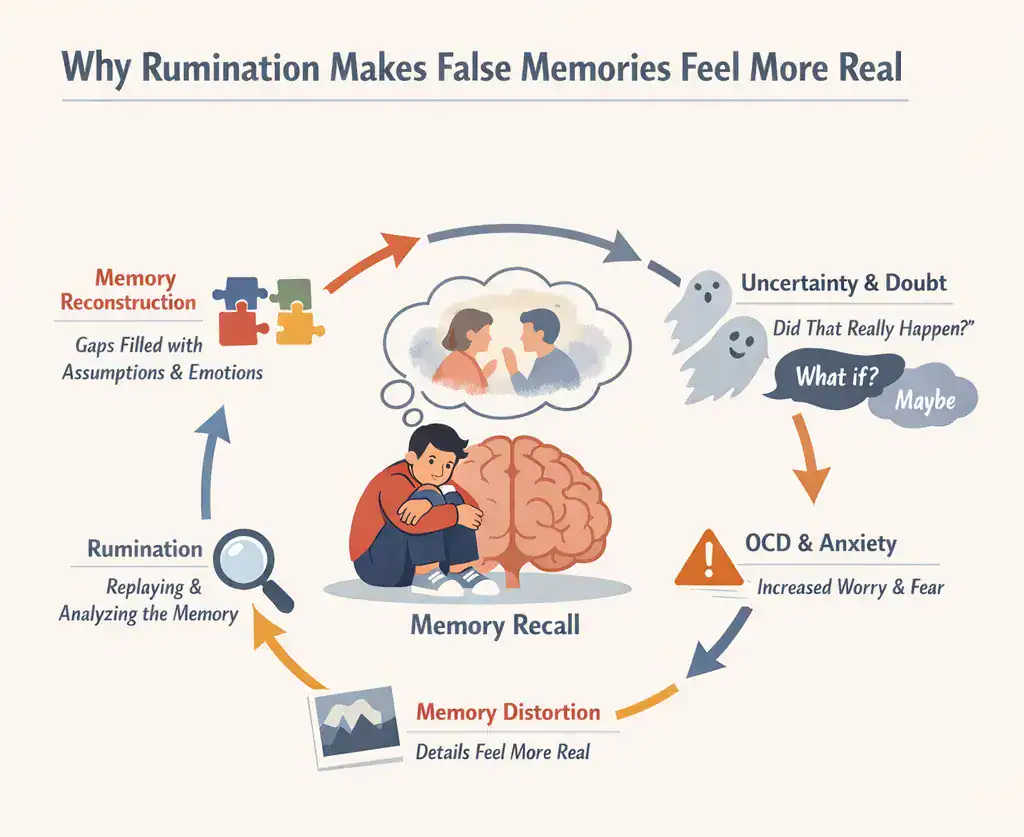
Research supports this pattern. A study published in Psychological Medicine found that people with OCD tend to be less confident in their memory and perception than they should be, suggesting a genuine under-confidence in this population.
When a person begins analyzing a memory repeatedly, anxiety increases. That anxiety makes the memory feel more emotionally significant, which can strengthen imagined details. Rumination then reinforces the cycle.
The more someone mentally reviews the event, the more distorted and uncertain the memory becomes. This creates the central paradox of false memory OCD: the harder someone tries to verify the memory, the less certain they feel.
Difference Between Ordinary Memory Uncertainty and False Memory OCD
Everyone occasionally questions their memory. In false memory OCD, however, the level of doubt becomes persistent, distressing, and compulsive.
| Ordinary Memory Uncertainty | False Memory OCD |
|---|---|
| Brief uncertainty about what happened | Persistent and intrusive doubts |
| Accepts ambiguity | Seeks absolute certainty |
| Moves on quickly | Replays the memory repeatedly |
| Little emotional distress | Intense guilt, anxiety, or shame |
Common Examples of False Memory OCD
False memory OCD can focus on many different types of situations.
Common examples include:
- Fear of having committed a crime, such as hitting someone with a car without realizing it.
- Worry about having behaved inappropriately at a party.
- Doubts about cheating on a partner or acting unfaithfully.
- Fear of having harmed someone accidentally.
- Worries about having said something offensive or inappropriate.
Common Compulsions in False Memory OCD
People with false memory OCD often engage in compulsions to try to resolve their doubts. As with all types of OCD, these behaviors can temporarily reduce anxiety but ultimately strengthen the OCD cycle.
These may include:
- Reassurance-seeking
- Mental checking and rumination
- Searching for evidence
- Avoidance
- Mental neutralization
- Confessing
- Over-monitoring emotions
Why Trying to “Figure It Out” Makes OCD Worse
One of the most frustrating aspects of false memory OCD is that the urge to solve the doubt actually makes the problem worse. The human brain cannot achieve perfect certainty about the past. Even very clear memories contain gaps and distortions.
When someone with OCD tries to analyze a memory repeatedly, they are essentially trying to solve an unsolvable puzzle. Each mental review introduces new interpretations, emotions, and imagined details. Over time, the memory becomes less stable rather than more accurate.
This creates what many therapists call the rumination trap. The person believes that if they just think about the event long enough, they will finally reach certainty. Instead, the opposite happens. The more they analyze the memory, the more doubt appears.

Breaking this cycle often involves learning to accept uncertainty rather than trying to eliminate it. This concept is closely related to psychological flexibility, which is a central principle in therapies such as ACT.
Effective Treatment for False Memory OCD
False memory OCD can feel overwhelming, but effective treatments are available. Several evidence-based approaches have been shown to help people regain control over obsessive doubt.
Exposure and Response Prevention (ERP)
Exposure and Response Prevention is considered the gold-standard treatment for OCD. In ERP, individuals gradually face the thoughts or situations that trigger their obsessions while resisting the urge to perform compulsions.
Over time, this helps the brain learn that uncertainty can be tolerated without engaging in reassurance-seeking or rumination. For example, someone might practice allowing the thought “Maybe I did something wrong, maybe I didn’t” without trying to mentally review the event.
Cognitive Behavioral Therapy (CBT)
Cognitive Behavioral Therapy helps individuals identify and challenge distorted thinking patterns that contribute to OCD. In false memory OCD, CBT may focus on beliefs such as thought-action fusion or the assumption that memories must be perfectly reliable.
By learning to recognize these cognitive distortions, individuals can begin to reduce the power of obsessive doubt.
Acceptance and Commitment Therapy (ACT)
Acceptance and Commitment Therapy emphasizes psychological flexibility rather than certainty. Instead of trying to eliminate intrusive thoughts, ACT encourages people to observe them with openness and distance.
The goal is to move forward with meaningful actions even when uncertainty remains. This approach can be particularly helpful for false memory OCD, where the core struggle revolves around the impossibility of achieving perfect certainty.
Medication
In some cases, medication may be recommended alongside therapy. Selective serotonin reuptake inhibitors (SSRIs) are commonly prescribed for OCD and can help reduce the intensity of obsessive thoughts and anxiety.
Medication decisions should always be made in consultation with a qualified mental health professional.
When to Seek Professional Help
Occasional doubts about memory are normal. However, professional help may be beneficial if intrusive doubts about the past begin to interfere with daily life.
Signs that it may be time to seek help include spending hours reviewing memories, repeatedly seeking reassurance, or avoiding people and situations due to fear of what might have happened.
If these patterns are causing significant distress or disrupting relationships, work, or sleep, speaking with a therapist experienced in OCD treatment can be an important step toward recovery.
FAQs About False Memory OCD
False memory OCD appears to be relatively common among people with obsessive-compulsive disorder. According to data from NOCD, 31.9% of their members with OCD reported experiencing this subtype in 2023.
Several digital therapy apps provide structured exercises based on evidence-based treatments such as CBT and ACT. These tools can help individuals practice mindfulness, cognitive defusion, and exposure exercises. While apps can be a helpful supplement, they are usually most effective when combined with professional therapy.
In false memory OCD, the person fears they may have done something wrong but lacks clear evidence that the event occurred. In real event OCD, the obsession focuses on something that actually happened, but the individual becomes trapped in excessive guilt, rumination, or moral analysis about the event.
False memory OCD often begins with a moment of uncertainty about a past event. This uncertainty triggers intrusive thoughts, which lead to rumination and compulsive attempts to verify what happened. Over time, the cycle of doubt and checking reinforces itself, making the memory feel increasingly convincing and distressing.
Leave a Reply